

What if the strategy everyone warns you about is the same one quietly running inside thousands of Malaysian trading accounts?
Strategi martingale comes with a simple promise: double your position after every loss, and a single win erases the whole losing streak.
On paper, it looks almost unbeatable.
In practice, perdagangan forex rarely behaves like paper.
Spreads widen, USD/MYR lurches on Fed announcement days, and execution costs nibble at the edge you thought you had.
That is where the real kebaikan dan keburukan surface — not in the win rate, but in whether your account survives long enough to recover.
A strong win rate means very little if one bad streak ends the account.
So the fair test is a side-by-side one: martingale versus fixed-risk trading, judged on the same four measures — account survival, true broker execution costs, USD/MYR event volatility, and signal-provider quality.
Both approaches can be traded badly, and both can be traded with discipline.
The difference is what happens when the market refuses to cooperate.
Quick Answer: The Martingale strategy in Forex trading means doubling our position after each loss to recover with just one win.
But we need significant capital to ride out any losing streaks.
While it may appear attractive due to its potential for rapid recovery, the strategy risks rapid account depletion during prolonged unfavorable market conditions.
Ultimately, the effectiveness of Martingale heavily depends on a trader’s capital and market behaviors.
What decision are we really making about strategi martingale?
What if the real problem with martingale isn’t the doubling itself—it’s that traders are often choosing between two different risk systems?
The decision underneath strategi martingale is whether you use a position-sizing rule that increases exposure after every loss, or a fixed-risk rule that keeps each trade the same size regardless of what came before.
Martingale relies on after-a-loss scaling so one win can recover earlier losses plus a small profit—only possible if you have enough capital and a win arrives before the account runs dry.
Fixed-risk trading instead risks a set percentage per trade, accepts the loss, and repeats the same sizing next time.
The two options, side by side
| Decision criterion | Classic martingale | Fixed-risk approach | Key question for the trader |
|---|---|---|---|
| Position sizing after a loss | Doubles/multiplies previous size | Fixed percentage of equity | Can your account fund the next step? |
| Maximum drawdown exposure | Can grow toward most of the account | Limited by per-trade risk & stop distance | What is the worst run you can survive? |
| Stop-loss discipline | Stops often removed/widened | Stop-loss set before entry and left | Are you managing the trade or drawdown? |
| Capital requirement | Large buffer for a long streak | Modest; each trade risks the same small amount | How much equity does the method assume? |
| Response to market trends | Ignores direction; bets on mean reversion | Follows the setup; cuts when it fails | Does it need a ranging market? |
| Suitability during major news | Wider spreads/slippage hit the largest position | Cost stays proportional to a normal trade | What happens in USD/MYR gaps around major events? |
The last row is the most critical for USD/MYR, because a doubling sequence inherits wider costs when spreads widen around a Fed decision or Malaysian data release.
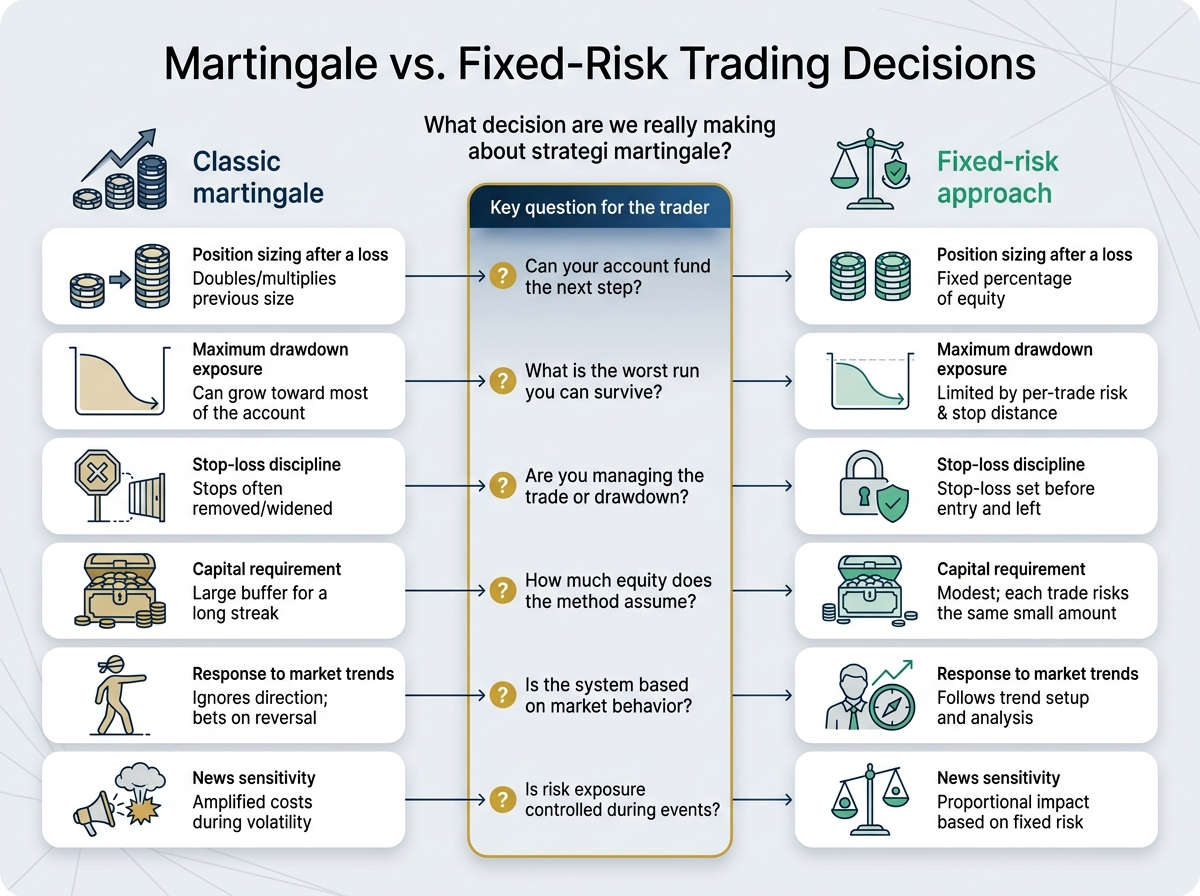
A quick comparison shows why the method feels attractive—and why it can fail
A string of recovered trades can look like proof of a solid system.
It isn’t proof of anything except that the losing streak hasn’t gone long enough yet.
Set the two approaches side by side on the same criteria and the gap shows up fast.
| Criteria | Martingale position sizing | Fixed-risk position sizing |
|---|---|---|
| Position size after a loss | Increases (typically doubles) | Unchanged |
| Capital at risk per trade | Grows with each loss | Held constant, e.g. 1% of balance |
| Exposure after five losses | According to Industry data, roughly 31x the first position | Still 1x |
| Margin requirement | Rises with position size | Predictable |
| Drawdown from one long streak | Can be severe | Bounded by the per-trade limit |
| Sensitivity to spread and slippage | Amplified on larger positions | Minor |
| Best suited to | Traders who accept sequence risk | Traders who plan for it |
| Loss number | Illustrative position size | Cumulative exposure | Approximate recovery requirement | Risk observation |
|---|---|---|---|---|
| Initial trade | 0.10 lots | According to research from Martingale Trading, USD 20 | 0.2% of balance | Comfortable |
| First increase | 0.20 lots | According to research from Martingale Trading, USD 60 | 0.6% of balance | Still easy to ignore |
| Second increase | 0.40 lots | According to research from Martingale Trading, USD 140 | 1.4% of balance | Margin use climbing |
| Third increase | 0.80 lots | According to research from Martingale Trading, USD 300 | 3.0% of balance | One slip hurts |
| Extended losing sequence | 1.60 lots and beyond | According to research from Martingale Trading, USD 620+ | 6.2%+ of balance | Margin call territory |
Check your maximum exposure, margin requirement, worst-case spread, slippage, and the longest losing streak your system could realistically produce—because a 70% win rate tells you nothing about whether you survive the other 30%.
A trader may recover losses—until the market stops behaving as expected
Imagine a trader who scores eleven straight wins on USD/MYR using a doubling rule, only to face a week where the pair just keeps climbing.
In the short run, the rule seems to do exactly what it promises: recover losses by forcing the next outcome to matter more.
After eleven straight wins, the account is still standing, and the trader can believe the method is “working as expected.”
But the doubling rule is built on a fragile premise: that market movement will alternate often enough for the trader’s recovery logic to catch up.
The streak phase hides that dependency.
When the market stops behaving like the trader planned—when the pair transitions into a persistent climb rather than offering the kinds of reversals the recovery plan needs—the same mechanism turns from a cushion into an accelerant.
That’s why the account survives the streak but not the week.
The trader may be right, trade after trade, that the next result will allow recovery to resume.
Yet in a prolonged trend, each new move pushes further away from the “back-to-expected” path.
Losses don’t get canceled out by later rebounds quickly enough, and the compounding effect of sizing decisions makes the required correction grow faster than the market supplies it.
So recovery can continue—until the market stops behaving as expected.
Which method fits the trader, market, and account constraints?
Which method fits the trader, market, and account constraints?
Neither approach is right or wrong in the abstract.
A method works best when our risk management rules, how the pair behaves, and broker execution costs all align.
Martingale has a hard time aligning all three.
Start with the rules that should exist before any signal is judged:
- Risk per trade: a fixed percentage or sum per position, decided in advance.
- Stop placement: a hard exit level, not hope that price returns.
- Maximum daily loss: the point where you stop opening new positions.
- Pause rule: automatic cooling-off after a set number of consecutive losses.
A doubling sequence swaps the stop for an averaging decision.
Fixed-risk keeps the stop and adjusts size instead, so the two need different guardrails.
Compare them on the same constraints:
| Constraint | Martingale | Fixed-risk |
|---|---|---|
| Risk per trade | Increases after each loss | Stays fixed |
| Maximum entries | Open-ended until margin runs out | Capped at a preset number |
| Portfolio exposure | Concentrated in one direction | Spread across independent setups |
| Shutdown rule | Rarely written down | Defined before the first trade |
A doubling sequence inherits a wider spread at every step, so cost drift belongs inside the comparison rather than in a footnote.
For anyone reviewing signals or teaching this material, judge the process rather than the headline win rate: verified history, drawdown depth, position sizing, costs, open exposure, and behaviour during high-volatility events.
The method worth following is the one whose worst case you can describe in advance, out loud, before it happens.
The right verdict depends on what we are willing to lose—and how clearly we can measure it
A capped, tested version of the doubling rule is still not a low-risk strategy.
Capping the sequence limits the damage; it does not change the underlying logic that a loss is being recovered by adding exposure.
Recovery remains a possibility, never a guarantee.
That distinction settles the comparison for most people.
If you are new to forex trading, or your account cannot absorb position sizes that climb quickly while margin requirements move with volatility, fixed-risk sizing is the safer default.
A tested, capped sequence can stay on the table—but only inside limits you have already written down.
Before committing real money, work through these checks:
- Maximum account loss: state the worst-case drawdown in currency, not as a vague percentage.
- Position-size limits: set a hard ceiling on lots per trade, regardless of where the sequence sits.
- Total trading costs: add spread, commission, and slippage across the entire sequence, not just the first entry.
- News exposure: define how you handle USD/MYR around Fed decisions and Malaysian data releases.
- Stop-loss logic: write down exactly where the sequence ends.
- Broker execution: test fill quality on a demo account during volatile sessions before trusting live fills.
- Documented exit: name the conditions that retire the method permanently.
Fixed-risk rules tend to survive these checks because the answers are fixed in advance.
Doubling rules often fail them because the honest answers keep changing with each step.
If you cannot complete every line, that gap is your verdict.
Apa strategi forex yang paling akurat?
Tidak ada strategi forex yang secara universal dianggap paling akurat.
Efektivitas strategi tergantung pada kondisi pasar dan kemampuan trader.
Strategi seperti Martingale dapat menarik, tetapi memiliki risiko tinggi yang mungkin tidak cocok untuk semua trader.
Kenapa banyak orang rugi dalam trading forex?
Banyak orang rugi dalam trading forex karena kurangnya pemahaman tentang risiko dan manajemen modal.
Selain itu, strategi yang terlalu agresif seperti Martingale dapat menyebabkan kerugian besar jika trader mengalami streak kalah yang panjang.
Berapa margin 1 lot jika 1/100?
Dengan 1/100, margin untuk 1 lot standar (100.000 unit) adalah $1.000.
Ini berarti Anda perlu menyediakan $1.000 sebagai jaminan untuk mengontrol posisi sebesar $100.000 di pasar forex.
Berapa persen orang gagal di trading forex?
Sekitar 70-90% trader forex diperkirakan mengalami kegagalan dan kehilangan uang.
Faktor utama yang menyebabkan kegagalan ini termasuk kurangnya pengalaman, strategi trading yang tidak sesuai, dan manajemen risiko yang buruk.
Is there a 100% profitable Martingale strategy?
There is no such thing as a 100% profitable Martingale strategy.
While it can potentially recover losses, it requires significant capital and bears the risk of total account depletion if a bad streak occurs.
What Survives a Bad Week Matters More Than What Wins a Good One
The pros and cons of the Martingale strategy stem from one crucial mechanism: it generates small, frequent wins but can lead to occasional catastrophic losses.
A USD/MYR gap after a Fed decision can turn three months of recovered losses into a margin call in minutes.
Fixed-risk sizing doesn’t win more often.
It keeps you in perdagangan forex long enough for the edge to matter, and it stays measurable even when real spreads widen during volatile news.
That discipline shapes how we compare broker costs and build risk guidance.
Before your next entry, calculate your maximum single-trade loss in ringgit, not lots.
If that number makes us flinch, we’ve probably sized our position too large.
Start there, and the martingale question answers itself.