

Have you ever spent a week perfecting your trades, only to have one bad entry wipe it all away?
The setup looks clean.
So why does one bad entry still erase a week of careful trades?
Because most people treat risk management as something you do after clicking buy.
Set the stop-loss, pick a target, then hope the market behaves.
Real risk control starts much earlier — before the trade exists.
Before you choose a direction, you decide what would prove you wrong.
That’s what the best forex strategy for managing risk before entering a trade actually looks like.
It’s less about predicting price and more about four quiet decisions.
Where does your idea become invalid? How much can your account lose without breaking your routine? What is the broker quietly taking in spread and commission? And is a scheduled event about to move everything?
Get those four right and the trade becomes a formality.
Get them wrong and no indicator will save you.
Quick Answer: The best forex strategy for managing risk before entering a trade relies on a systematic approach.
We need to define our thesis, invalidation point, risk amount, position size, and execution cost.
By clearly separating market, account, execution, and event risks, traders can make informed decisions that protect their capital, thereby minimizing losses before committing to a trade.
Implementing this pre-entry process enhances decision quality and ensures that risk is managed proactively.
What does strategi forex terbaik untuk mengurus risiko sebelum masuk trade mean?
Why do so many traders only start thinking about risk once a position has turned red? Because risk management gets taught as a repair job.
It isn’t one.
The best forex strategy for managing risk before entering a trade is a chain of decisions you make while you are still calm and still holding nothing.
When traders ask what the strategi forex terbaik untuk mengurus risiko sebelum masuk trade really means, the honest answer is that ordering: thesis, invalidation point, risk amount, position size, execution cost, event check.
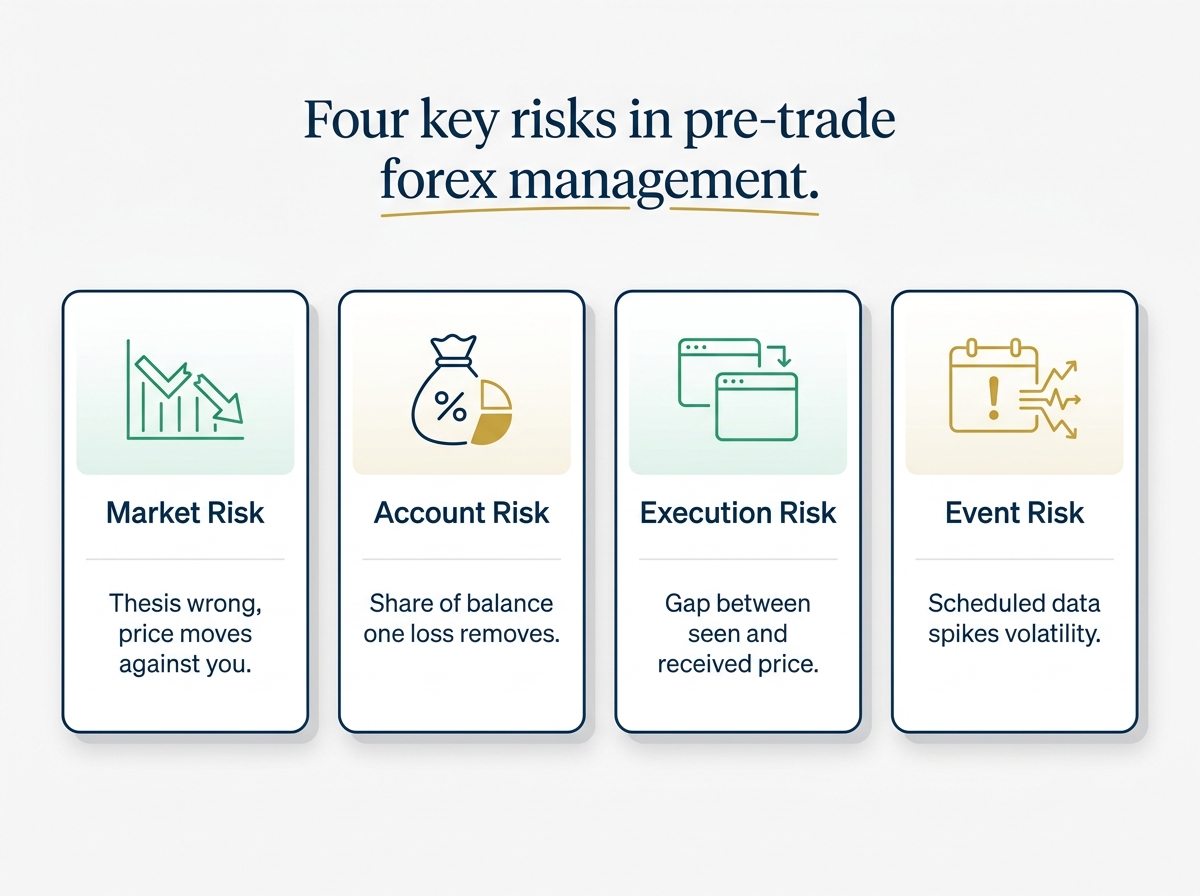
Four separate risks sit behind it.
- Market risk: your thesis being wrong and price moving against you.
- Account risk: the share of your balance that one loss removes.
- Execution risk: the gap between the price you see and the price you get.
- Event risk: scheduled data or central bank decisions that spike volatility.
Treating those four as one blurry threat is why so many beginners size positions by feeling.
Separating them turns risk into something you can weigh before you commit.
A pre-entry process improves decision quality.
It does not delete losses.
Some trades will still fail, and a few will fail for reasons no checklist captured.
What you control is the size and frequency of the damage.
Why a pre-trade risk process matters for Malaysian forex traders
A few hundred ringgit lost on a ‘small’ trade can be a result of poor strategy or market conditions, rather than just bad luck.
It usually isn’t.
is what makes a tiny position look harmless: a 0.10 lot on USD/MYR barely registers on screen, but your real exposure is multiplied by your ratio—often far more than beginners expect.
Add spread, commission, and swap (the overnight financing charge), and the cost of simply holding keeps climbing.
Trade size and risk size are two different numbers, and confusing them is how a modest entry turns into an outsized loss.
USD/MYR traders also inherit an event calendar they don’t control.
Federal Reserve rate decisions and US Treasury yield moves drive dollar strength, and the ringgit can react sharply in the minutes after a release.
Liquidity tends to thin out during Malaysian evening hours, which can widen spreads right when an entry looks most tempting.
Even the best signals won’t solve this problem.
Even a careful provider has no idea what your account balance is or how much drawdown—the peak-to-trough fall in your equity—you can actually stomach.
What turns a checklist into a genuine strategi forex terbaik untuk mengurus risiko sebelum masuk trade is that your risk limit, not the signal, decides how much you commit.
Pre-entry risk checklist
| Risk question | What to check | Acceptable condition | Action if the condition fails |
|---|---|---|---|
| Account risk | Risk per trade as a share of equity | A fixed small percentage you set in advance | Cut position size or skip the trade |
| Stop-loss distance | Pips between entry and invalidation level | Based on market structure, not account comfort | Reassess the setup; don’t widen the stop |
| Spread and commission | Live spread plus per-lot commission | Cost leaves realistic room for your target | Wait for a calmer session or change broker |
| Upcoming high-impact news | Economic calendar for Fed and US data releases | No major release inside your holding window | Delay entry or reduce size deliberately |
| Expected reward relative to risk | Reward-to-risk ratio of the full plan | At least the minimum ratio your plan requires | Pass on the trade |
It also removes the temptation to enter first and rationalise later.
How the pre-trade risk framework works from idea to order
Risk starts before you click Buy.
The pre-trade framework turns one idea into a chain of decisions: what would prove it wrong, how much you’ll lose if it is wrong, what the trade will really cost, and whether an upcoming event breaks your assumptions.
Start by writing the thesis in plain terms, then define the invalidation point (the exact level/condition where the market thesis stops being true).
Only after that do you pick the stop-loss from market structure (support/resistance, swing highs/lows), not from a preferred lot size.
- Set the thesis and invalidation: “If price closes beyond X,” the setup is invalid.
- Choose the stop from structure: Place the stop where the chart story is disproved.
- Calculate position size from account risk: Use
risk = account risk%, thenlots = risk / (stop_pips pip_value), where pip value is the account currency profit/loss per pip per lot. ** amplifies that exposure, so size—not hope—controls drawdown (peak-to-trough equity drop). - Price the real execution costs: Check spread (ask–bid), commission (broker fee), swap (overnight interest), and slippage (worse fill than expected). Even if the stop is correct, these costs can still change outcomes.
- Event check → go/no-go: If news or a high-volatility window increases slippage risk, either reduce size, widen cost buffers, or cancel.
Educational example (USD/MYR): With a RM10,000 account risking 1% (RM100), a 25-pip stop means the position size must be small enough that a 25-pip loss lands near RM100 after pip value math—then you stress-test against spread and potential slippage using your broker’s pricing, plus your event calendar.
For broader context, review USD/MYR market analysis, risk-managed trading guidance, and broker comparison.
This workflow doesn’t promise safety; it keeps losses explainable, measurable, and controlled.
Examples, mistakes, and misconceptions about forex risk management
Two traders act on the same USD/MYR idea and use the same 40-pip stop.
The difference is not the analysis or the invalidation point—it’s the position size.
One trader’s setup is sized so the stop represents 1% of a RM20,000 account.
The other trader scales the trade up so the same 40 pips translates into 4% risk, simply because the position is four times larger.
Now let price move against both traders and trigger their stops.
According to zforex.com, the first trader exits at the stop and loses RM200.
The second trader also exits at the stop, but because they were exposed to four times more size, their loss is RM800.
This is the core lesson: identical stop distance does not guarantee identical damage.
Two trades can share the same “where you’re wrong” level and still produce very different outcomes because risk management is the bridge between “what level breaks the idea” and “how much money that break costs.” A useful analogy is a speed limit sign versus the vehicle you’re driving—the sign may be the same, but the risk you carry depends on what you built to go with it.
That gap is where most pre-trade risk management misconceptions begin: treating the stop in pips as the whole risk story, instead of sizing the trade so the stop corresponds to a controlled fraction of the account.
Applying the framework: limits, broker decisions, and a repeatable pre-trade routine
Imagine running the framework once—it’s easy, right?
Running it every time, on every pair, in every mood, is what separates a process from good intentions.
We can keep our routine simple with a one-page worksheet.
Six lines cover the whole decision:
- Thesis and invalidation point: what you expect, and the price that proves you wrong.
- Risk in ringgit: the loss you accept, expressed as a percentage of the account.
- Position size: lots calculated from that figure, never chosen by feel.
- Real execution cost: spread, commission, and an allowance for slippage.
- Event check: USD/MYR-relevant data or Fed commentary due within 24 hours.
- Verdict: enter, wait for a better price, or skip.
Three conditions should stop you outright.
A spread far wider than your plan assumes — thin liquidity around daily rollover can quietly double a round-trip cost.
A structure you cannot describe: if you cannot state the invalidation level in one sentence, there is no trade to manage.
And a major release sitting inside your holding window, where a rate decision can gap straight through a stop.
Comparing brokers follows the same logic.
Headline “0.0 pip” spreads rarely reflect what you pay when commission, swap, and typical slippage are included.
Estimate total cost per round trip, on the pairs and session hours you actually trade, then rank.
After the trade closes, record planned risk against actual execution — fill price,
Apa strategi forex yang paling akurat?
Strategi forex yang paling akurat adalah yang mengutamakan manajemen risiko sebelum memasuki perdagangan.
Ini melibatkan keputusan sistematis, seperti menentukan tesis, titik invalidasi, jumlah risiko, ukuran posisi, dan biaya eksekusi untuk melindungi modal.
Apa kunci sukses dalam trading forex?
Kunci sukses dalam trading forex terletak pada penanganan risiko yang proaktif dan terencana.
Trader harus membuat keputusan yang matang tentang ukuran posisi, titik invalidasi, dan biaya sebelum melakukan transaksi, sehingga dapat meminimalisir kerugian.
Apa aturan 90% dalam forex?
Aturan 90% dalam forex sering mengacu pada kenyataan bahwa 90% trader mengalami kerugian.
Hal ini menekankan pentingnya manajemen risiko yang tepat dan pemahaman tentang pengelolaan ukuran posisi untuk meningkatkan peluang sukses.
Trading forex paling bagus jam berapa?
Trading forex paling baik dilakukan ketika pasar aktif, biasanya saat overlap antara sesi Asia dan Eropa, sekitar pukul 14:00 hingga 18:00 WIB.
Pada saat-saat ini, volatilitas dan likuiditas meningkat, memberikan lebih banyak peluang bagi trader.
Return to USD/MYR once more.
A trader who checked US Treasury yield moves, sized the position against account equity, and confirmed real spread and commission costs before entering wasn’t caught off guard.
They hadn’t predicted the outcome; they had defined what would prove them wrong first.
That sequence is the strategy.
The best forex risk management before entering a trade isn’t a secret indicator or perfect entry—it’s four calm decisions made before money is exposed.
Before your next order, write down your invalidation level, position size, true cost estimate, and calendar event risk.
If you can’t answer all four, you’re not ready to click buy.
For a structured starting point, our broker comparison and risk guidance can help.